
Livestock Supply Chain Insurance for Australian Beef and Meat Operations
Livestock supply chain insurance protects every link between paddock and processor — the genetics on the breeding farm, the feed contracts at the feedlot, the carcasses on hook at a third-party plant, and the cartons of finished product moving toward domestic and export buyers. For vertically integrated beef businesses and high-value cattle producers, a standard farm pack is rarely enough.
At Agripro Insurance Brokers, we build livestock insurance programs for producers and meat businesses across Australia, structured around the commercial realities of long-term genetic investment, capital-intensive feeding, and contract-driven supply. According to Meat & Livestock Australia, the red meat sector is one of the country’s largest agricultural industries by export value, and the operational complexity has grown alongside it.
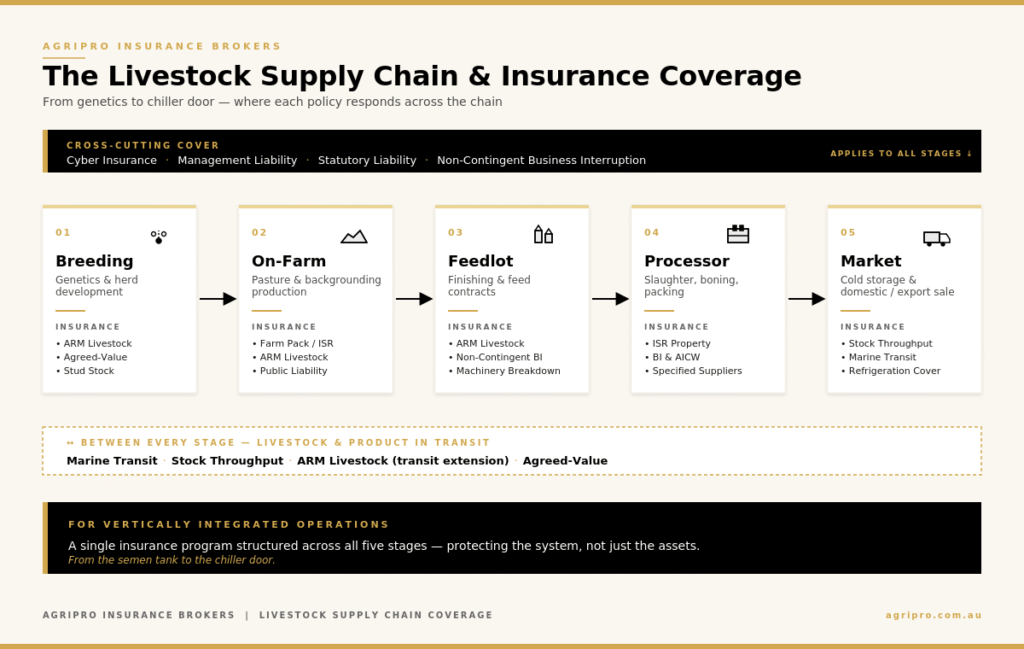
What livestock supply chain insurance covers
A tailored program for a livestock supply chain typically includes:
- All Risks Mortality (ARM) cover for animals on-farm, in transit, and at third-party feedlots or processors
- Marine Transit and Stock Throughput insurance for chilled and frozen meat product
- ISR property and business interruption cover, including non-contingent extensions
- Cyber, management liability, and statutory liability cover
- Agreed-value cover for stud and high-genetic-value animals
The right structure depends on where value is concentrated in your operation, how exposed you are to third-party providers, and the contract terms attached to your supply. For dedicated beef and feedlot operations, the program also needs to address feed dependency, pen-throughput interruption, and contracted live weight obligations.
All Risks Mortality (ARM) livestock insurance
All Risks Mortality cover protects livestock against death from accident, illness, or disease wherever the animals are located — on-farm, in feedlots, in transit, or in third-party feeding and processing facilities. Unlike defined-events farm pack cover (typically limited to fire, lightning, and limited accidents), ARM provides protection through the full production cycle. It also responds to livestock disease outbreaks, an exposure that can affect entire batches of animals at once.
For producers running stud, breeding, or high-genetic-value programs — including those operating under specialist livestock insurance programs — ARM should be combined with agreed-value cover so that settlement reflects genetic and replacement value rather than commercial market rates.
Marine Transit and Stock Throughput cover
Once livestock has been processed, the product becomes a moving asset across cool rooms, freezers, transport networks, and export terminals. Marine Transit and Stock Throughput insurance covers meat in transit and at third-party storage facilities, with refrigeration and frozen clauses to protect against temperature failure, contamination, and spoilage. Standard property insurance does not extend to this exposure.
This becomes critical when product is held at a third-party processor or at port awaiting export shipment. Without it, a refrigeration failure or storage incident at a facility you do not own can become an uninsured loss.
Business Interruption and ISR Property — including non-contingent cover
Insured loss to your own property is only one part of the supply chain risk picture. Operational interruption can also flow from:
- A loss at a contracted third-party processor that limits kill space
- A feed supplier hit by a cyber incident or fire
- A transport partner unable to deliver
- Restricted access to export-licensed facilities
A well-structured ISR property and business interruption program can be extended to specified suppliers and customers, with Additional Increased Cost of Working built in to fund alternative transport, kill fees, or reroute costs.
Real claim example — supply chain disruption
A contracted third-party meat processor used by an Agripro client suffered an insured loss that included approximately $5 million of finished product on hook. The client faced reduced income because alternative facilities had limited kill space, leaving them unable to fully meet supply contracts. Additional transport costs were incurred to move and process livestock at a substitute plant.
The client’s insurance program responded across two sections:
- Marine Transit, including refrigeration and frozen clauses, protected meat in storage and transit
- ISR Property and Business Interruption, with extensions for specified suppliers and Additional Increased Cost of Working, funded the additional transport and kill fees
Combined, the program protected against both physical loss and the operational and financial impact of disruption outside the client’s direct control.
Livestock transit and agreed-value insurance
Transport is one of the most overlooked, highest-impact components of a livestock operation. Moving high-value animals between farms, feedlots, reproduction centres, and processors exposes them to road accidents, heat stress on long hauls, loading and unloading injuries, and weather delays. For Wagyu, stud, and elite-genetic programs, a single rollover or load incident can be a six- or seven-figure exposure.
Real claim example — agreed-value cover for Wagyu transit
An Agripro client experienced a truck rollover while transporting 60 Wagyu heifers. The animals were insured under an agreed-value policy reflecting their genetic value, not standard cattle rates. Settlement covered full replacement value rather than market price, avoiding a substantial uninsured gap.
Agreed-value cover is essential where:
- Standard market rates do not reflect the replacement cost of elite sires or donor cows
- Forward contracts are in place and a loss affects both immediate revenue and future obligations
- Genetic programs depend on continuity, and losing a single high-index animal sets back breeding schedules and progeny pipelines
Cyber and non-contingent business interruption
Modern livestock supply chains depend on third parties and digital systems. Two common scenarios highlight the exposure.
Real claim example — ransomware on a feed supplier
A feed supplier used by a feedlot was hit by a ransomware attack that halted deliveries across multiple Wagyu properties. Operations without non-contingent business interruption cover absorbed the cost of feeding delays, lost weight gain, and contract penalties.
Real claim example — phishing and fraudulent payment
An accounts officer acted on a fraudulent email requesting payment to a substituted bank account. The deception was not identified until $250,000 had been transferred. The loss was indemnified under the company’s cyber insurance program, which included a social engineering extension.
The takeaways for any livestock business:
- Reliance on third parties means your operation can be impacted even when nothing on your farm is damaged
- Digital systems, from accounting software to traceability platforms, are increasingly targeted, and the financial consequences can be catastrophic
- Cyber policies should specifically cover invoice manipulation, CEO impersonation, email compromise, and social engineering
- Non-contingent business interruption cover should align with actual exposure to suppliers and customers
Management liability and internal risk
As livestock and meat operations expand, internal risks grow alongside the value of the business. These exposures are often unnoticed until a major loss occurs.
Common issues include:
- Employee dishonesty — theft of livestock funds, manipulated accounts, or intentional damage to animals or equipment
- Regulatory breaches across workplace safety, environmental compliance, or contractual non-conformance
- Workplace disputes including unfair dismissal, bullying allegations, and shareholder disagreements
Real claim example — workplace health and safety prosecution
An Agripro client was investigated after an employee sustained serious injuries operating feeding equipment at a feedlot. The regulator alleged failures around safe systems of work, plant guarding, and staff training. The business faced prosecution under workplace health and safety legislation, with significant defence costs and potential pecuniary penalties.
The company’s management liability policy responded under the Statutory Liability section, covering legal representation costs and contributing toward pecuniary penalties (subject to policy terms and legislative allowances).
Management liability cover is particularly important for:
- Operations expanding into branded beef or processing, where payrolls, production systems, and legal responsibilities all grow
- Protecting relationships with partners, processors, and investors by demonstrating robust internal risk management
- Ensuring that internal mismanagement or deliberate acts do not derail long-term breeding and production strategies
Why an integrated approach matters
In a typical insurance program, livestock, processing, transport, liability, and management cover are treated as separate risks. In a livestock supply chain, they are inseparable. A feeding delay disrupts processor contracts. A genetic loss sets back years of breeding work. A machinery breakdown compromises export supply. A cyber incident at a supplier halts your own kill schedule.
At Agripro Insurance Brokers, we structure cover around the full flow of value through your operation — from the semen tank to the chiller door — protecting the system, not just the individual assets. Working with a specialist farm insurance broker who understands the supply chain end-to-end is what makes that integration possible.
Frequently asked questions
What is livestock supply chain insurance?
It is an integrated insurance program that protects livestock, livestock products, and the operational continuity of a beef or meat business at every stage of the supply chain — including on-farm, in transit, at third-party feedlots and processors, and during storage and export.
Who needs livestock supply chain insurance in Australia?
Vertically integrated beef and meat businesses, large-scale feedlots, stud and Wagyu producers, and any operation that depends on third-party processors or contracted suppliers. The greater your reliance on partners outside your direct control, the greater the case for non-contingent and stock throughput cover.
What is All Risks Mortality (ARM) cover?
ARM is livestock insurance that responds to death from accident, illness, or disease wherever the animals are located, in contrast to defined-events farm pack cover, which is typically limited to fire, lightning, and named accidents.
How is agreed-value insurance different from market-value cover?
Market-value settlements reflect commercial cattle prices at the date of loss. Agreed-value settlements reflect a value declared at policy inception, typically based on genetic merit, breeding contracts, or independent valuation. For Wagyu, stud stock, and elite breeding animals, agreed-value cover prevents a settlement gap when commercial rates do not match replacement cost.
What is stock throughput insurance?
Stock throughput insurance covers livestock products (typically meat) in transit and at third-party storage and processing facilities. It often includes refrigeration and frozen clauses for chilled and frozen product. It fills a gap that standard farm and property insurance does not address.
Does cyber insurance cover phishing and invoice fraud?
Cyber policies vary significantly. A well-structured policy for a livestock business should include extensions for social engineering, invoice manipulation, CEO impersonation, and funds transfer fraud. Without these specific extensions, a fraudulent payment loss may not be covered under a basic cyber policy.
Talk to Agripro about your livestock insurance program
If your business runs across the livestock supply chain — breeding, feeding, processing, transport, or export — your insurance program should respond as a single, connected structure. Contact Agripro to review where value sits in your operation and how your current cover responds.