Why Use A Farm Insurance Broker

Why should I use farm insurance broker?

This topic highlights the expertise and personalised service provided by farm insurance brokers, emphasizing their role in managing complex risks and offering industry-specific advice.

The trend towards larger farm sizes and corporate farming is altering the risk landscape for many agricultural operations. These larger entities are increasingly diversifying their activities, making traditional, standardized farm insurance policies inadequate.

It is crucial for these larger agricultural operations to collaborate with a farm insurance broker who specializes in agricultural risk management and can provide access to top-tier farm insurance solutions.

Should I Use Farm Insurance Brokers?

Farm insurance brokers represent your interests rather than those of the insurers. They offer guidance to help you effectively manage the risks associated with your farm and will identify and implement the most suitable insurance solutions tailored to your specific operational needs.

In contrast to an insurance broker, a direct insurer often has restricted access to a variety of products and pricing options. It is essential for larger farms to have access to a wide range of insurance products, both domestically and internationally.

What Do Farm Insurance Brokers Do?

  • Review and assess potential farm risks
  • Work on behalf of your farm business, not on behalf of the insurer
  • Source multiple insurance products and pricing within the market
  • Have a thorough understanding of the insurance market and the ability to negotiate premiums on your behalf
  • Manage claims on your behalf including lodgment and negotiation with the insurer to provide the best possible outcome
  • Remain up to date with policy wordings, industry changes and emerging farm insurance risks
farm insurance brokers aerial view of fruit orchard in Australia

Emerging Risks For Agriculture

Farm Liability Insurance

Farm Labour Hire

As farms have grown, so too has the use of contractors and labour hire personnel. The use of labour on farms has changed significantly over the past decade.

It is important that a farm insurance broker is utilised to ensure the most appropriate farm liability insurance is sourced for your farm business, taking into consideration the use of labour hire and contractors engaged.

Farm Export Insurance

Australia exports 70% of the total value of agriculture, fisheries, and forestry production.  

Fruit and vegetable exports have increased by 69% and this sector continues to be the most reliant on labour hire, casual labour and contractors.

Many larger farms within the horticultural and beef sector are now exporting directly overseas and it is important that these risks are considered not only for liability but also for marine and trade credit insurance for farms.
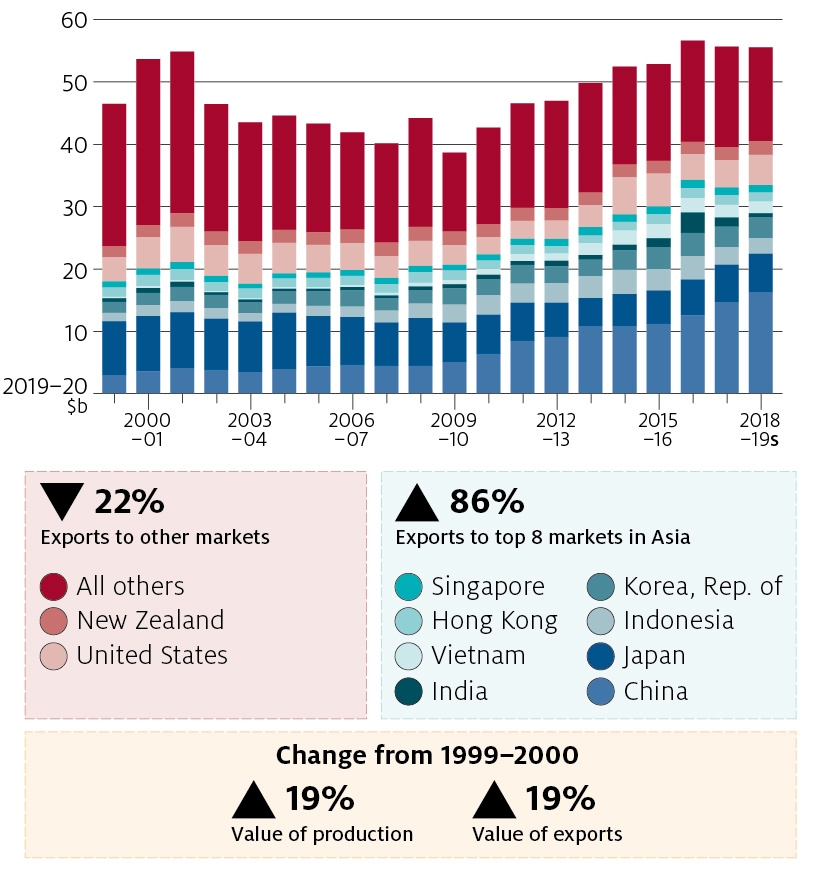
Graph chart showing Agriculture, fisheries and forestry exports by destination
Agriculture, fisheries and forestry exports by destination
Source: www.agriculture.gov.au/abares

Farm Liability Insurance Policy Coverage

There are significant differences in farm liability policy wordings including claims made vs claims occurrence and geographic restrictions. A farm insurance broker will have the ability to advise on the most appropriate liability cover for your farm.

Product Recall Insurance For Agriculture

With many larger farms now supplying retail supermarkets directly, the costs associated with product recall due to contamination and maintaining brand reputation can be significant. On average, nearly 10 product recalls occur every week within Australia, with food and beverage being the most commonly recalled products.

Product Recall Liability Insurance For Farms Can Provide Cover For:
  • Accidental contamination
  • Product tampering
  • Product extortion
  • Alleged contamination
  • Government recall
  • Adverse publicity
  • Reworking costs
  • Business interruption
Graph chart showing the number a food recalls within Australia
Number of food recalls coordinated by FSANZ each year, shown by recall classification
Source: www.foodstandards.gov.au/industry/foodrecalls

Farm Livestock Insurance

Australia is recognised for having one of the most effective biosecurity programs globally. The severe consequences of disease outbreaks, such as African Swine Fever and Foot and Mouth Disease, have been evident in agricultural economies abroad. Australian farms are now operating at higher intensities with increased livestock numbers, which can elevate financial risks.

The rise of free-range farming, particularly in egg and poultry production, also heightens the potential for diseases to be introduced from wildlife, including migratory birds.

For many intensive and free-range farming operations, the risks extend beyond the financial loss of livestock. There is also the potential disruption to farm operations and supply chains if government-imposed quarantine measures are enacted. A recent example occurred in Victoria, where several farms were quarantined due to an outbreak of highly pathogenic H7N7 avian influenza.

At Agripro Insurance Brokers, we offer customised livestock insurance solutions for poultry farms, poultry processors, piggeries, and beef feedlots, which can include coverage for business interruption in the event of government quarantine or livestock slaughter.

Poultry farm insurance brokers. White chickens within a poultry shed

Farm Management Liability Insurance

Management liability insurance is a well-established product but it is frequently neglected in the agricultural industry.

In Australia, the agriculture sector employs more than 300,000 individuals. As labor demands and corporate responsibilities rise, the risks associated with agricultural operations have escalated significantly. Over the last ten years, there have been substantial updates to occupational health and safety regulations in Australia, particularly with recent changes implemented in Victoria in July 2020.

Ongoing legislative developments are further elevating the risk landscape for agricultural enterprises, making it essential for any farming business or partnership to evaluate the necessity of farm management liability insurance.

Farm Management Liability Insurance Can Provide Cover For:
  • Directors & officers liability insurance
  • Statutory liability insurance for fines or penalties including
    • EPA
    • Occupational Health and Safety
  • Employment practices liability
    • Unfair dismissal
    • Workplace harassment
    • Failure to employ or promote
sheep in yards with two farmers and a dog

Drought Insurance for Farms

Index insurance is based on an agreed predetermined index that will pay out in the event of weather related or catastrophic events. Index insurance does not generally require the use of claims assessors so it will allow the claims process to be much quicker and more factual for farms.

Weather index insurance is already being used by many cropping farms where the predetermined index is developed prior to the commencement of the policy.

Weather Index Perils That Can Be Insured:
  • Insufficient or excessive rainfall
  • Extreme temperatures including
    • frost
    • humidity
    • windspeed
  • Seasonal rainfall
How Farm Weather Index Insurance Is Used:
  • Insufficient rainfall that results in a reduced crop yield
  • Excessive rainfall and wet harvest cover resulting in reduced yield or downgrade
  • Frost that results in a reduction of yield
  • Reduction in seasonal rainfall

Weather Index Insurance For Agriculture

Weather index insurance can also be considered for agricultural suppliers or processors who may be indirectly impacted by weather related events.

Examples Of Weather Index Insurance Applications:

Fertiliser Suppliers
Farms within the specified region receive below average rainfall which results in a reduced volume of fertiliser being used. The reduced volume used on farm impacts the financial income of the fertiliser business.

Meat Processors
A reduced seasonal rainfall results in lower processing numbers for a meat processing facility which financially impacts the business.

Milk and Cheese Processors
Farms that supply the dairy company received below average rainfall within the region, which reduces the milk yield and financial income of the milk processing company

Agricultural Investment
A portfolio of agricultural operations managed by an investment fund receive below average rainfall for the season which impacts the investment return for the company and shareholders.

Agripro Insurance Brokers have access to over 150 global insurance products we can provide customised agricultural insurance solutions for any large or corporate farm. Australian farms are highly diversified and our experts have global market access and knowledge to help manage your risk.

How To Insure Farm Solar Panels

Farm Insurance for solar panels is an important risk to consider within any farm insurance program. With the increasing cost of power and reliability during peak periods, farmers are looking for energy alternatives to better manage their power requirements.

Farm Insurance for solar panels is an important risk to consider within any farm insurance program. With the increasing cost of power and reliability during peak periods, farmers are looking for energy alternatives to better manage their power requirements.

Solar is fast becoming a standard energy alternative for farms, as it suits the peak demand of a number of farming operations. It is also popular for running water pumps  where the distance and locations of pumps can difficult and expensive for the connection of mains power.

Sheep grazing on grass in front of farm solar panels

From an insurance perspective it’s important to consider;

  • How the solar panels are installed on the farm
  • How the solar panels are being used on the farm and;
  • The financial impact to the farm in the event of insured loss or damage

The Sum Insured Of Farm Solar Panels

The first consideration is the sum insured for the panels and associated equipment. Many farms have had access to government grants which may not be available should replacement be required. The full replacement cost of the panels, freight and installation should always be included within the sum insured.

The Location Of Farm Solar Panels

The location of the panels is important, as panels could either be

  • Fixed to existing farm sheds
  • Free standing supplying power for water pump systems
  • Ground mounted as part of a whole farm power supply system.

The location will determine the best method to insure the panels within an insurance policy.  They could be considered as part of the overall building sum insured which can include fixed power, water and gas within some policy wordings. Alternatively, they could be insured as part of the water pumping system which includes the power supply or more commonly insured as a separate listed item.

The Use Of Farm Solar Panels

It’s important to understand the use of the panels and how they being used to supply power to the farm. Is the unit completely off the grid, dual switching set up or used for individual water pumps/irrigation equipment. The use helps determine what the potential financial impact could be in the event of insured loss or damage to the solar system.

Farm solar panels in rural Australia

Farm Financial Impact

Farm Business interruption insurance cover may not be considered when discussing the use of solar panels but the conversation should not be any different than any other essential services that the farm utilises.

The financial impact can vary depending on the use of the panels on the farm. Some panels could be used to supply stock water to locations that aren’t always used throughout the year, whereas some panels could be used to supply power to a 60 unit rotary dairy with battery storage.

In the event of loss or damage, not only could a farm incur financial impact from a reduction in production but it could also incur additional power and generator costs to maintain the farm operation while the panels are reinstated.

Power supply is always something that should be discussed as part of the farms business interruption cover as their use, ability and timing to replace is an important factor to consider.

Farm Insurance Policy Wordings

Coverage in the market varies with a number of farm insurers . Some insurers include cover for solar panels within the building sum insured as part of fixed services while others require solar systems to be specified under specific policy sections.  

How they are insured under the policy can also effect the cover provided, as some farm insurers will provide Accidental Damage cover while others limit the cover to Defined Events only.

An ISR farm insurance policy can include cover, so long as it is listed within the declared asset schedule.  It’s important that the Accidental Damage sub-limit is adequate within the policy and that the business interruption cover is tailored to cover such financial risk exposures.

Farm Insurance for solar panels can be quite complex and it’s important that you deal with farm insurance broker who is highly experienced in agricultural operations.

Farm Business Interruption Insurance

Farm business interruption insurance cover is a vital component for any farm operation. While the importance of business interruption insurance for commercial business is well documented, it's less well recognised in the farming sector. However, it is just as important, if not more so, that farms have adequate business insurance interruption cover due to their increased external risk exposure.

Farm business interruption insurance cover is a vital component for any farm operation. While the importance of business interruption insurance for commercial business is well documented, it’s less well recognised in the farming sector. However, it is just as important, if not more so, that farms have adequate business insurance interruption cover due to their increased external risk exposure.

This article reviews the different farm insurance options that are available for agricultural operations.

Insurance To Suit Your Farm Business

Like all insurance policies, business interruption cover needs to suit your individual requirements, in particular your farm occupation.

Intensive farming operations such as poultry, eggs and piggeries require key infrastructure to ensure that the business can operate and process batches throughout the year.  Most pastoral operations don’t rely on key infrastructure, and therefore, any loss of farm infrastructure may not have a significant financial impact on the business. In these cases, the business may require an alternative solution to a gross profits interruption cover.

Farm Business Interruption Insurance For Intensive Farming- Gross Profits Insurance

In terms of poultry farms, a gross profits business interruption insurance cover is vital to ensure that in the event of insured loss or damage to property, expenses can continued to be paid. Should there be a loss to a single shed or multiple sheds, it will ensure that there is minimal financial impact to the farm until property is reinstated and bird batches can continue to operate.

The calculation of insuring intensive farming operations is no different to commercial businesses in that uninsured working expenses would be deducted from the annual turnover in order to derive an insurable gross profits figure. It’s also vital that it is understood how the farm is being paid under a processor contract, as these can differ in the market.

Example – Poultry Farm (12 months indemnity period)

Calculation for gross profits value:

Annual turnover                                                                                      $1,000,000
Less uninsured working expenses (e.g. gas*, power* and litter)     $170,000
Insurable gross profits                                                                       $830,000

* Always ensure that the fixed connections charges within power and gas costs are not deducted as uninsured working expenses, as these costs will still remain in the event of loss or damage to farm infrastructure.

Key Considerations for Farm Gross Profits Insurance:

  • Suitable for farms that are reliant on key infrastructure
  • Will cover the farms loss of gross profits
  • Uninsured expenses will differ depending on the farm occupation and farm input costs
  • Labour should be included within insurable gross profits to ensure employment costs are covered in the event of an insured loss
  • Underinsurance clauses apply (check your policy)
  • Consider full mortality livestock insurance extending to cover business interruption cover
Front of two green poultry shed with three silver grain silos with blue sky

Business Interruption Insurance For Pastoral Operations

Pastoral operations can be a little more complex, however they are certainly no more difficult to insure under a farm insurance policy. For example, if a pastoral operation was to lose a hay shed, it is more than likely that the farm would not incur any financial interruption to their livestock sales or production. Pastoral operations are usually more exposed to the risk of increased costs that the farm may incur in order to continue to grow and sell livestock. Therefore, a cover such as ‘Increased Cost of Working’ can be better suited to these types of operations.

See our article on livestock insurance

Birdseye view of sheep in yards being sorted for shearing

Business Interruption Insurance For Dairy Farms

Dairy farms can effectively be insured for either gross profits cover and/or ‘Increased Cost of Working’ cover. ‘Increased Cost of Working’ cover is well suited to dairy farms as they must continue to milk cows and cannot simply close their doors and receive payments for loss of gross profits. A continuation cover, such as ‘Increased Cost of Working’, is well suited to dairy farms as it covers additional costs that the farm may incur in order to continue to milk cows without disruption to animal lactation and calving patterns, which would ultimately have a long term impact on the farms production.

See our article on insurance cover for loss of milk

Milking cows on a rotary dairy

What Is Farm Business Interruption “Increased Cost of Working” Cover

‘Increased Cost of Working’ cover can not only be used in the event of insured loss or damage to property, but under some farm insurance policies, cover can also be provided for costs such as re-sowing of pasture in the event of grass fire. Other additional costs that may be considered under the policy for business continuation purposes may include, purchasing additional fodder to keep cattle fed while pastures are reinstated, additional labour costs that the farm incurs, and even transport or lease costs should cattle need to be agisted or milked on another property. 

‘Increased Cost of Working’ is an elective sum insured and will not generally incur any underinsurance clauses.  As a result, it can be difficult to calculate the most appropriate sum insured for a farm.

Considerations for calculating the sum insured should include:

  • Costs of re-sowing fire damaged pastures (including seed & labour)
  • Farm consultancy fees
  • Additional labour costs to feed or milk cattle
  • Fodder costs to feed livestock while pastures are reinstated and back in rotation
  • Any livestock transport or lease costs should cattle be required to be moved to an alternative farm or dairy

Feed costs can represent a large portion of the required sum insured for ‘Increased Cost of Working’ cover. This can be due to the timing of the loss and various seasonal conditions that may increase the length of time required to have pastures back in working rotation

Key Considerations of Farm Increased Cost of Working Insurance:

  • Elective sum insured without any underinsurance clauses
  • Used to cover costs the farm incurs to continue the farming business- not loss of income
  • Insurance cover for fire damaged pasture can be covered by some insurers
  • No economic limit in terms of dollars spent versus income returned
  • Can be a more cost effective premium than gross profits insurance

Business interruption insurance for agricultural risks can be complex to insure and will vary depending on the occupation and the individual farm activities. It is important that your insurance broker is experienced in agricultural risks and has an in-depth understanding of the farm to ensure adquite protection